Monday, January 26, 2015
"After Cybersyn"
I wrote a short piece of games-focused alternate history for Memory Insufficient's most recent issue (Volume 2, Issue 6, for the sake of time-traveling historians of the future).
It's about Chilean Cybernetics (Cybersyn), avant-garde latin american fiction, and what computer games might be like if they had been born from somewhere besides the American military-industrial complex. More of it is based on fact than you might imagine, though I regret to inform you that Robert Kennedy was not elected in 1968.
Download the issue for free. It also includes some games history madlibs written by guest-editor Rachel Simone Weil.
Sunday, November 30, 2014
Cascadia, Bioregionalism, and Sense of Place in Game Design (Lost Levels 2014)
Lost Levels is one of my very favorite yearly events, if an event can be called so in its second year of existence. Held in Yerba Buena Gardens on the thursday of the weeklong Game Developers Conference, it is a free and radically inclusive unconference/picnic. Crowds gather under arcadian boughs to hear speakers hold forth on deep or amusing topics, or to take part in discussions about what game studies is, or to engage in non-competitive dance-offs. It feeds the soul and reminds us of the communicative testament of not using powerpoint.
Naturally, I have gotten swept up in the proceedings, and given talks the last two years about topics which I care about but the average indie game developer/critic/weirdo might not be aware of. Last year I ranted for five minutes on “Postmodern Sports,” explaining the alienation of the college athlete and comparing Alabama football to a nineteenth-century army. This year, I talked about Cascadia, bioregionalism, and fostering a greater sense of place in game design.
Games writer Marshall Sandoval was in attendance, and recently mused on the topic of "Regional Authenticity" in this PopMatters post, so I figured it was time to write up my talk. This is faintly updated based on some more recent information, but it carries over the gist of what I meant to say.
Wednesday, March 12, 2014
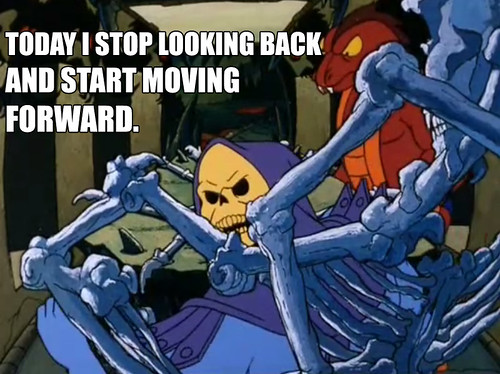
On Skeletor Affirmations and Supervillain Psychology
If you and I are 'friends' on facebook, you may have seen me sharing images from "Skeletor is Love," now active for roughly one year. It's been buzzfed, and blogged, and anthologized, and fed through, and yet I still find it worth following.
In part, it is because the figure of Skeletor provides an ironic, tongue-in-cheek vehicle for straightforwardly earnest and possibly corny statements. I can feel safe that my social-media-hologram will not be negatively affected by sharing it, because the text is adjoining Skeletor, rather than a picture of a skinny white woman doing yoga on a beach. Of course, I also appreciate being gently uplifting, knowing that for all our snark, of the dozens of people who might see my post, one of them might really need it. It's a challenge to be positive and helpful without resorting to smarm. (This is one of the reasons that for all my wariness of TED-talk-types, I refrain from throwing Jane McGonigal under the bus.)
That's all well and good, but why Skeletor? Why not He-Man (or She-Ra) affirmations? I think this has something to do with the figure of the villain in an episodic cartoon format, and how that relates to positive thinking.
In part, it is because the figure of Skeletor provides an ironic, tongue-in-cheek vehicle for straightforwardly earnest and possibly corny statements. I can feel safe that my social-media-hologram will not be negatively affected by sharing it, because the text is adjoining Skeletor, rather than a picture of a skinny white woman doing yoga on a beach. Of course, I also appreciate being gently uplifting, knowing that for all our snark, of the dozens of people who might see my post, one of them might really need it. It's a challenge to be positive and helpful without resorting to smarm. (This is one of the reasons that for all my wariness of TED-talk-types, I refrain from throwing Jane McGonigal under the bus.)
That's all well and good, but why Skeletor? Why not He-Man (or She-Ra) affirmations? I think this has something to do with the figure of the villain in an episodic cartoon format, and how that relates to positive thinking.
Saturday, September 28, 2013
LOVEINT, a piece of surveillance poetry
I dreamt
last
night
that I was being
tracked
followed monitored judged desired by
the best surveillance man in the business
that he could tell I wanted him
even when I looked a picture of normality
that his dark gaze could pierce me
whenever he turn't it toward me
and never often enough.
I dreamt
that everything I did had an audience
that the secret significance of my actions
had someone to appreciate them.
I dreamt
of chemtrails and HAARP arrays
and distant lovers,
desirous of my scent like the old stasi
watching me
waiting
aching for an excuse to render me
extraordinarily
I woke.
Friday, September 6, 2013
Outside Lands and vexilology (Or: the importance of having a flag)
Last summer I went to Outside Lands, the great big music festival held in Golden Gate Park. I had not really been to a major music festival before. Stepping into the sea of humanity friday evening, I rapidly came to the following observations:
- My subjective geography of the park had been massively altered by filling it with people. A plain that once took a minute to cross could now take half an hour to scoot and elbow through.
- Everyone was making a futile effort to call their friends, taxing the cell system and making it impossible to get a call through. SMS was an option, but it might take 20 minutes for the text to get through, assuming your friend even has their phone charged.
- My friends seemed to be in various altered states, and not necessarily good at finding needles in haystacks.
- Standard methods of finding your friends are therefore woefully inadequate.
Sunday, August 25, 2013
Airs, Waters, Places...Smells?
I think a lot about smell, as you might have guessed from my having written a magazine article about it for an offbeat quarterly. Today I find myself musing about odors, ritual, and sacred spaces.
It's no surprise that incense and its ilk are associated with religio-magical practices beyond written history. its ability to mark and recall deep memories is well-attested, and the entire practice of aromatherapy is based on its power to subtly alter moods at an almost pre-conscious level. Beyond sacred circles, geometrically-bewitching architecture, or striking acoustics, making a place sacred starts with making it smell different.
I realized this, as it happens, while waving a burning smudge of white sage around my campsite at dusk, muttering "repel ghosts," a meme-worm picked up from Basquiat via my art-friend Superchief Jeronimo. The phrase felt like the right thing to say at the time, but I had no intentions of a supernatural nature: I just wanted the damn mosquitoes to back off.
Friday, May 24, 2013
Half Lives
Poetry
is just like mining Radium,
said Mayakovsky.
He was right,
in more ways than he imagined.
is just like mining Radium,
said Mayakovsky.
He was right,
in more ways than he imagined.
Wednesday, May 1, 2013
STFC: Success
OBSESSED WITH INVISIBLE DETAILS
— ▉▊▋▍▎▏ (@n__l) May 1, 2013
I convened a bunch of friends and weirdos together Tuesday night for the inaugural round of SECRET TWITTER FILM CLUB. The result, as you might gather from the title, was an smashing success.
Results can be viewed & perused here.
Thursday, April 25, 2013
Cocktails, murder, and treason: a stay at the McKittrick Hotel
[Cross-posted from the Duncan/Channon Tumblr, because attribution is forever.]
The design was amazing, building out a world of shops, bars, cemeteries, forests, and darkly-haunted nurseries into five stories of warehouse. The light and sound had a sculptural quality typically limited to installation art. Being as site-specific as it was, the result was a mind-blowing union of set design and choreography: dancers would haul each other up to run on the walls and vault over pool tables, or slither through exposed stone windows. The performances were wordless, physically-demanding, and just this side of otherworldly.
If you’re in New York in the next month, go. Take friends. Get there early. Wear shoes you can sprint in. Consider taking a lock-picking class. Read the Sparknotes for MacBeth and watch Hitchcock’s Rebecca. Practice running up flights of stairs at full speed. And remind yourself that even then, you’re not going to see everything, but you’re going to see great things. And perhaps, if you are lucky and daring, you’ll get to be the one that gets taken aside, ushered into the locked room, and trusted with a dark secret. If not, well, now you understand why people are coming back half a dozen times.
Score: FIVE OUT OF FIVE BLOODY DAGGERS
Sleep No More runs at The McKittrick Hotel, 530 West 27th Street, New York, NY. Running time varies depending on entrance time, but is between 2 and 3 hours. Performances begin nightly between 7 and 8pm, with additional late night performances Friday and Saturday starting between 11pm and midnight. Tickets must be purchased in advance at http://www.sleepnomorenyc.com/
[Pictures via Mordicai]
I am somewhere in midtown Manhattan, in the 20s near the High Line. I am watching MacBeth murder Banquo with a brick, put on his suit jacket, and sprint out. I follow. My nose is sweating under my mask, it’s dark and hard to see, and I end up losing him around a corner. But I notice an interesting (and more sparsely attended) interaction going on across the hall between one of the witches and the god-fearing tailor, and veer over to watch that. Why does she have a key around her neck? What does it unlock? And who is that lost-looking young woman with the suitcase?
Welcome to the McKittrick Hotel, home to Sleep No More, an immersive theater experience that just might be New York’s best show and worst-kept secret. With zero advertising, they’ve been able to consistently sell out shows at rates of $75 to $95 per ticket, with high repeat visits, some up to seven or eight times.
It had been something I’d been meaning to see since it opened, but hadn’t quite found the right time/friends/money over the last two years. But, on hearing rumors that the British-based group that put it on will finish up their run in June and head back across the pond, I knew it was something I had to jump on.
I went last Sunday with a friend, though we were quickly separated in the opening rush of action. This was actually a preferable outcome, as we were able to compare notes afterward (“You didn’t see the strobe-light witch rave?” “You didn’t see Lady MacBeth and the out-damn-spot?”)
The design was amazing, building out a world of shops, bars, cemeteries, forests, and darkly-haunted nurseries into five stories of warehouse. The light and sound had a sculptural quality typically limited to installation art. Being as site-specific as it was, the result was a mind-blowing union of set design and choreography: dancers would haul each other up to run on the walls and vault over pool tables, or slither through exposed stone windows. The performances were wordless, physically-demanding, and just this side of otherworldly.
If you’re in New York in the next month, go. Take friends. Get there early. Wear shoes you can sprint in. Consider taking a lock-picking class. Read the Sparknotes for MacBeth and watch Hitchcock’s Rebecca. Practice running up flights of stairs at full speed. And remind yourself that even then, you’re not going to see everything, but you’re going to see great things. And perhaps, if you are lucky and daring, you’ll get to be the one that gets taken aside, ushered into the locked room, and trusted with a dark secret. If not, well, now you understand why people are coming back half a dozen times.
Score: FIVE OUT OF FIVE BLOODY DAGGERS
Sleep No More runs at The McKittrick Hotel, 530 West 27th Street, New York, NY. Running time varies depending on entrance time, but is between 2 and 3 hours. Performances begin nightly between 7 and 8pm, with additional late night performances Friday and Saturday starting between 11pm and midnight. Tickets must be purchased in advance at http://www.sleepnomorenyc.com/
[Pictures via Mordicai]
Wednesday, April 24, 2013
The Thin Duke's Testament
A channelling of the existential dandy, with apologies to Messrs. Mann, Marinetti, Nietzsche, and Bowie.
////////
My sickness began early. From man I expected divine virtue or hair-raising wickedness; from life either ravishing loveliness or else consummate horror; and I was full of avidity for all that and of a profound, tormented yearning for a larger reality, for experience no matter what kind, let it be glorious and intoxicating bliss or unspeakable, undreamed-for anguish.
Do not fear lest I go on to recount my disappointments in detail. Enough to tell you that I learned to hate the poets for what they made me crave.
////////
Do not presume to know whence I came, nor what I expect.
My sickness began early. From man I expected divine virtue or hair-raising wickedness; from life either ravishing loveliness or else consummate horror; and I was full of avidity for all that and of a profound, tormented yearning for a larger reality, for experience no matter what kind, let it be glorious and intoxicating bliss or unspeakable, undreamed-for anguish.
Do not fear lest I go on to recount my disappointments in detail. Enough to tell you that I learned to hate the poets for what they made me crave.
What is the mark of decadence? The whole no longer resides in the part. The whole no longer lives at all: it is composite, calculated, artificial, and artifact. We are those calculations, we are the artifacts, because it is the only honest occupation left.
It is my favorite activity to gaze at the starry heavens by night, standing quite alone, like lighthouses or the sentinels in an outpost, facing the army of enemy stars encamped against us. Perhaps it may be pardoned in me that I still cling to my distant hopes, waiting for the divine invasion to unchain all horizons and give me something to feel. We are the Fifth Column for the ecstatic.
We are chameleons, shape-shifters, immaculate travelers between worlds. We walk, we stroll, we amble, we leap, we drag vicious beasts on leashes, all with the grace of effortless effort. Everything we do is art.
We are of the present, the eternal Now. When we have turned decrepit, let those younger and stronger souls cast us aside like useless manuscripts. They will crowd around us, exasperated by our proud indefatigable courage. They will hurl themselves forward to destroy us, with all the more hatred as their hearts will be drunk with love and admiration for us.
I have no reason to die unless it is the desire to be rid of the too great weight of my courage.
Let us don white and stroll through the darkness that roars, seeing and being seen.
Let us feed the unknown, not from despair, but simply to enrich the unfathomable reservoirs of the Absurd.
Let us now praise the senses – the only true proofs of existence.
Here I am, flashing no colour, tall in this room overlooking the ocean
Every mask I wear becomes a shield, a weapon, a horse, a home.
Here I am again, a vision in blank, throwing darts in lovers' eyes.
Take refuge in the mirror. Bind your reflections with that well-knotted necktie,
(Silk, to be sure. Nothing less, and nothing more.)
Come live with me in the mirror; there we might better share our echoes.
Here we are again, donning velvet armor and striding forth to seek, to strive, to find, and not to yield
Here we are.
One moment to spin dreams and shout forth an insolent challenge to the stars.
One moment, this moment.
Here we are again.
Take it while you have it.
Friday, April 19, 2013
Words of advice for young people
Last February found me back east for a meeting of the trustees of WPRB, my old college radio station. I had been in communication with the events chair of dear old Terrace F. Club, and was invited to give an installment of their series of Talks with Interesting People Accompanied by Drinks.
Princeton in particular but Ivies in general encourage certain temperaments and behaviors: the theoretical over the practical, the critical over the active, the verbal over the physical. Furthermore, the sort of person who gets in tends to have gotten there by staying on the rails: do what you're told, delay gratification, seek affirmation from success within hierarchical systems. Looking ahead to my five-year college reunion this May, I figured I'd finally write up my reflections.
It's been part of my self-work over the past five years to jump those rails. I didn't know what I was really doing at the beginning, but over time I've pulled together scraps and pieces from various different sources of inspiration, into something that begins to approach an "approach."
Tuesday, April 16, 2013
Vintage repost: "The Saurian in Winter"
Digging through my old Facebook notes, I found this. I still enjoy its "Frank Sinatra Has a Cold" style opening, and the world it evokes in only a few hundred words. I'm thinking about expanding it into a Twine game. Enjoy.
///////
Autumn comes early on the moon. The automated climate controls, carefully engineered to match the swelter of the late Cretaceous, were nonetheless skewed by the minute fluctuations of orbit that took the moon about an inch further from earth per year. I was welcomed by a robotic servant and taken into the impressive bubbledome parlor, lovingly adorned with retro-futurist décor that screamed 1965. Fitting for the retired supervillain once declared “mightier than all the nations.”
Tyrannus Rex might be considered best as two separate identities (not including the heroic alter-ego from an alternate universe that Rex battled during the Stockholm Incident of 1968); There is the hyperintelligent dinosaur with opposable talons I took tea with in the parlor, and then there is the larger-than-life public figure, the idea of Tyrannus Rex, that stomped on the terra (both figuratively, literally) and commanded the world stage for most of my life. As always, my interlocutor was possessed of the impeccable grace and elocution that comes from kidnapping the great orators of history from various timelines and forcing them to teach you rhetoric, the silvery forked tongue that put presidents and diplomats to shame during his career.
“But of course, young mammal,” he explained, “Force can lay the world in your jaws, but only eloquence can bid it lie still and accept the inevitable. This fact would have been made crystal clear in 1976 were it not for the intercession of Cimon and the rest of the Cross-Time Athenians. They were glorious in those days, even I their sworn enemy had to admit.” [editor’s note: the Cross-Time Athenians come from a divergent timestream in which an observer from the future was found out in 445 B.C. and forced to yield up his time-traveling equipment to Pericles and the Assembly.]
Ultimately, however, the former “Lizard-King of Cincinnati” remains phlegmatic about his infamies. The scars that cover his weathered, scaly exterior mark a time long past, before reality television and celebrity culture. Beyond that, the private sector has proven simply more lucrative. By his estimation, Tyrannus Rex now makes more from consulting fees (his unique knowledge of villain psychology has put more than a few of his former colleagues in the League of Nation-Smashers behind bars, or in the case of Amorpho, laser security grids) and corporate speaking engagements (his usual topic is “the will to greatness”) than he ever did as a megalomaniacal threat to global security.
“It’s the old law, as true in Cicero’s time as ours,” he says with the same sense of resignation I heard during my interview with [Ex-Soviet supergroup] the Red Guards: “Cash rules everything around me…”
///////
Autumn comes early on the moon. The automated climate controls, carefully engineered to match the swelter of the late Cretaceous, were nonetheless skewed by the minute fluctuations of orbit that took the moon about an inch further from earth per year. I was welcomed by a robotic servant and taken into the impressive bubbledome parlor, lovingly adorned with retro-futurist décor that screamed 1965. Fitting for the retired supervillain once declared “mightier than all the nations.”
Tyrannus Rex might be considered best as two separate identities (not including the heroic alter-ego from an alternate universe that Rex battled during the Stockholm Incident of 1968); There is the hyperintelligent dinosaur with opposable talons I took tea with in the parlor, and then there is the larger-than-life public figure, the idea of Tyrannus Rex, that stomped on the terra (both figuratively, literally) and commanded the world stage for most of my life. As always, my interlocutor was possessed of the impeccable grace and elocution that comes from kidnapping the great orators of history from various timelines and forcing them to teach you rhetoric, the silvery forked tongue that put presidents and diplomats to shame during his career.
“But of course, young mammal,” he explained, “Force can lay the world in your jaws, but only eloquence can bid it lie still and accept the inevitable. This fact would have been made crystal clear in 1976 were it not for the intercession of Cimon and the rest of the Cross-Time Athenians. They were glorious in those days, even I their sworn enemy had to admit.” [editor’s note: the Cross-Time Athenians come from a divergent timestream in which an observer from the future was found out in 445 B.C. and forced to yield up his time-traveling equipment to Pericles and the Assembly.]
Ultimately, however, the former “Lizard-King of Cincinnati” remains phlegmatic about his infamies. The scars that cover his weathered, scaly exterior mark a time long past, before reality television and celebrity culture. Beyond that, the private sector has proven simply more lucrative. By his estimation, Tyrannus Rex now makes more from consulting fees (his unique knowledge of villain psychology has put more than a few of his former colleagues in the League of Nation-Smashers behind bars, or in the case of Amorpho, laser security grids) and corporate speaking engagements (his usual topic is “the will to greatness”) than he ever did as a megalomaniacal threat to global security.
“It’s the old law, as true in Cicero’s time as ours,” he says with the same sense of resignation I heard during my interview with [Ex-Soviet supergroup] the Red Guards: “Cash rules everything around me…”
Friday, April 12, 2013
Secret Twitter Film Club
Secret twitter film club (STFC) is a game of shared stimulus and strategic ambiguity.
It is inspired by Secret Book Club, a club wherein friends all read the same book at the same time, but are forbidden from discussing it directly. Ideally, one would more easily see how one’s reading bled into their conversation and writing, without direct commentary.It is a project in the spirit of @Timescanner’s invocation, “Hey everyone, let’s have experiences together,” and a rumination on the cryptic transparency of digital youth, progentitors of the subtweet. Other influences include the great tradition of jokes under communism, campus games of "Assassin," and the secret handshakes of Freemasonry.
Most importantly, Secret Twitter Film Club is secret.
RULES
- You are not to publicly reveal that you are taking part in Secret Twitter Film Club, nor when it is occurring. (STFC CAN HAPPEN AT ANY MOMENT. BE ON THE WATCH.)
- You will be sent a message with the name of the film, the time it is to occur, and the other participants. Times will be selected with a bias to North America. (If this seems impossible for you, feel free to start your own game of Secret Twitter Film Club).
- Perhaps obviously, you cannot give the name of the film you are watching, nor its particularly iconic lines/characters. Try and focus on elements and pieces that are of general interest, but have hidden meanings for fellow watchers.
- You cannot publicly reveal who *else* is in on Secret Twitter Film Club. (If you make a list of other players, for god’s sake keep it secret.) Winks, nods, and coded phrasetalk are perfectly okay presuming you do not blow each others’ covers with your sudden thick-as-thieves-ness.
- If one of your followers figures out that you’re playing Secret Twitter Film Club, you are “wounded” and must continue by appending the hashtag #SecTFC to your (hopefully cryptic) tweets. At this stage, the secret is what film it is.
- If one of your followers figures out what film you’re watching, the jig is up, at least for you and the other wounded. You may continue watching the film, though, and feel free to comment using the hashtag #OvTFC (for “overt twitter film club”)
If you want to play Secret Twitter Film Club, send an email to instigation [at] SplendidVagabond {dot} info that includes your twitter handle, interest in the game, and film preferences.
BONUS PARANOID VARIANT: If I get a sufficiently large body of players, I will split them into teams watching different, but thematically linked films. You will only know the players on your team. Extra points will be given to those who root out other teams' players.
Thursday, March 14, 2013
Mark Twain's Focus Group
You think that copy-testing and market research started in the 1930s and 40s with the popularization of survey research after Gallup and Roper's triumph in predicting the 1934 election.
YOU'D LIKE TO THINK THAT.
Actually, like all other aspects of modern American life, from long-distance relationships to fantasy stock-picking, it was actually envisioned by Mark Twain:
"Whenever I am about to publish a book, I feel an impatient desire to know what kind of a book it is. Of course I can find this out only by waiting until the critics shall have printed their reviews. I do know, beforehand, what the verdict of the general public will be, because I have a sure and simple method of ascertaining that. Which is this—if you care to know. I always read the manuscript to a private group of friends, composed as follows:
1. Man and woman with no sense of humor.
2. Man and woman with medium sense of humor.
3. Man and woman with prodigious sense of humor.
4. An intensely practical person.
5. A sentimental person.
6. Person who must have a moral in, and a purpose.
7. Hypercritical person—natural flaw-picker and fault-finder.
8. Enthusiast—person who enjoys anything and everything, almost.
9. Person who watches the others, and applauds or condemns with the majority.
10. Half a dozen bright young girls and boys, unclassified.
11. Person who relishes slang and familiar flippancy.
12. Person who detests them.
13. Person of evenly-balanced judicial mind.
14. Man who always goes to sleep.
These people accurately represent the general public. Their verdict is the sure forecast of the verdict of the general public. There is not a person among them whose opinion is not valuable to me; but the man whom I most depend upon—the man whom I watch with the deepest solicitude—the man who does most toward deciding me as to whether I shall publish the book or burn it, is the man who always goes to sleep. If he drops off within fifteen minutes, I burn the book; if he keeps awake three-quarters of an hour, I publish—and I publish with the greatest confidence, too. For the intent of my works is to entertain; and by making this man comfortable on a sofa and timing him, I can tell within a shade or two what degree of success I am going to achieve. His verdict has burned several books for me—five, to be accurate."
For more information, check out Who is Mark Twain?
Monday, February 25, 2013
Dispatch: The All-Worlds Fair
| ||
Wednesday, December 12, 2012
Once again, a published author (somehow).
![]() |
| The infamous Stasi smell-jars. |
My piece is called "Under the Iron Snout: A First Take on Olfactory Imperialism," and I promise it will include "Drug-sniffing dogs, fermented fish and mosquito repellent in Vietnam, the Stasi’s smell archives, People Sniffing, and strategies to survive smellveillance."
Investigate! Buy a copy! Tell your local artsy/intellectual/radical bookstore to start carrying THE STATE.
Thursday, July 19, 2012
If you ask it...
So, there was the time I wrote a question on Quora, and it blew up the whole internet, getting onto io9 and Boingboing:
It was instant bait for being spread around. All the ingredients were there: a shareable form, an instantly thought-provoking juxtaposition, the combination of military tactics and Disney. But it was a far different matter to see it take off as it did. By now over 60,000 people have viewed the question on Quora. Far more have likely thought about it via another site.
Based on the response, I hereby propose a new RULE OF THE INTERNET:
Rule 77: The more specific and/or absurd a request is, the more likely it is to receive expert assistance.
It was instant bait for being spread around. All the ingredients were there: a shareable form, an instantly thought-provoking juxtaposition, the combination of military tactics and Disney. But it was a far different matter to see it take off as it did. By now over 60,000 people have viewed the question on Quora. Far more have likely thought about it via another site.
Based on the response, I hereby propose a new RULE OF THE INTERNET:
Rule 77: The more specific and/or absurd a request is, the more likely it is to receive expert assistance.
Tuesday, June 12, 2012
VERY QUICKLY
[Post peak oil resilient communities]
+ [low-energy computing]
+ [internet of things]
+ [adaptation of past technologies]
---------------
SOLARPUNK.
+ [low-energy computing]
+ [internet of things]
+ [adaptation of past technologies]
---------------
SOLARPUNK.
Wednesday, April 11, 2012
Blast from Future Past: Rock Blastaar and the Radio Rangers
I finally got around to uploading Rock Blastaar and the Radio Rangers to Soundcloud. It was created in 2007 as part of WPRB's inaugural membership drive. We were hesitant about the classic PBS/NPR gambit of what I jokingly referred to as "holding the music hostage," but not sure how to express it in a way that affirmed what we felt WPRB was about. Late one Friday night after my show we started recording silly promos for the upcoming drive, and hit on the notion that Dr. Cosmo had actually taken the music hostage, in classic supervillain form. From there it was snapping on the lego pieces of the collective sci-fi unconscious, with some clear influence from the Firesign Theater.
It was an interesting, if consciously anachronistic project: create seven serial episodes over the course of the weeklong membership drive, culminating with a live and in-person finale sunday night. It was a mighty (and perhaps foolhardy) undertaking, but it the first creative project I came to that was really my own. I went after it with passion, writing, recording, and editing the episodes in fairly rapid succession. As the week wore on and I ran on less and less sleep, and thankfully had the much-needed help of Zoe Saunders and my brother Brendan Flynn writing the scripts to the last few episodes. It also gave me an in-depth understanding of the pace and demands of writing radio plays on a regular basis, which proved exceedingly useful in my senior thesis, an analysis of the 1938 "War of the Worlds" broadcast and its role in the burgeoning field of communications research.
Alex Basile and I also developed a sequel in 2009. We concepted it in Princeton that summer, but I actually recorded most of my lines in Cambodia and sent to him to stitch into the finished whole. Thomas Friedman may be kind of foolish, but the world is a lot flatter than it used to be.
It was an interesting, if consciously anachronistic project: create seven serial episodes over the course of the weeklong membership drive, culminating with a live and in-person finale sunday night. It was a mighty (and perhaps foolhardy) undertaking, but it the first creative project I came to that was really my own. I went after it with passion, writing, recording, and editing the episodes in fairly rapid succession. As the week wore on and I ran on less and less sleep, and thankfully had the much-needed help of Zoe Saunders and my brother Brendan Flynn writing the scripts to the last few episodes. It also gave me an in-depth understanding of the pace and demands of writing radio plays on a regular basis, which proved exceedingly useful in my senior thesis, an analysis of the 1938 "War of the Worlds" broadcast and its role in the burgeoning field of communications research.
Alex Basile and I also developed a sequel in 2009. We concepted it in Princeton that summer, but I actually recorded most of my lines in Cambodia and sent to him to stitch into the finished whole. Thomas Friedman may be kind of foolish, but the world is a lot flatter than it used to be.
Friday, February 10, 2012
Gothama: a game of non-attachment
The last weekend of January is quickly becoming a sort of annual holiday for me. It certainly involves sitting around and eating a lot, but that's not the focus. No, dear friends, the last weekend in January is the time of the Global Game Jam.
Sanctioned by the International Game Developers Association, the Game Jam is a mad dash to make a working game (usually, but not always, a video game) in 48 hours. Teams assemble on the spot based on appropriate balances of skills and abilities. Last year, I was sort of the utility infielder (writing, audio, and miscellaneous inspiration) of a team that already had an experienced game designer, but this year I ended up taking on the role. For someone who has read a ton about games, but not actually made many, this was tremendously exciting.
The theme for the year was an image of ourobouros, the snake that eats its tail. To me, it brought up associations of eternal recurrence, death, and rebirth. That brought me to the buddhist notion of Saṃsāra, and the suffering associated with endless fruitless repetitions of the cycles.
Which, in the context of video-gaming, instantly took me to thinking about stupidly-hard games of the NES era.
These were games that forced the player to memorize complex geometric patterns and punished them for a single infraction. These were games that decided that the best way to increase replayability was to tell players after the final battle that their entire first run of the game was "a trap devised by Satan" and force them to play it over again at an even more difficult level. These were games where your entire motivation for risking virtual life and limb was proving that you were a bad enough dude to rescue the president. They may have had different surface trappings, but ultimately they were games about suffering.
Gothama was thus a loving tribute and a philosophical critique of classic 2D platform gaming. It is at its highest level a stoic/buddhist/vedic-inspired critique of the ‘little pleasures’ of videogaming: the jingle of coins, a satisfying stomp, a well-timed dash and jump. We relish the shot of dopamine we get, the ability to feel greater than ourselves, but to what extent do they lead us to towards the short-term and ephemeral rather than our greatest good? Gothama makes uses of the tropes of the genre to make a point about non-attachment.
What point, you ask? Well, I suppose you'll have to play it to find out.
Which, in the context of video-gaming, instantly took me to thinking about stupidly-hard games of the NES era.
These were games that forced the player to memorize complex geometric patterns and punished them for a single infraction. These were games that decided that the best way to increase replayability was to tell players after the final battle that their entire first run of the game was "a trap devised by Satan" and force them to play it over again at an even more difficult level. These were games where your entire motivation for risking virtual life and limb was proving that you were a bad enough dude to rescue the president. They may have had different surface trappings, but ultimately they were games about suffering.
Gothama was thus a loving tribute and a philosophical critique of classic 2D platform gaming. It is at its highest level a stoic/buddhist/vedic-inspired critique of the ‘little pleasures’ of videogaming: the jingle of coins, a satisfying stomp, a well-timed dash and jump. We relish the shot of dopamine we get, the ability to feel greater than ourselves, but to what extent do they lead us to towards the short-term and ephemeral rather than our greatest good? Gothama makes uses of the tropes of the genre to make a point about non-attachment.
What point, you ask? Well, I suppose you'll have to play it to find out.
![]() |
| Click here to download the special edition of Gothama. |
Subscribe to:
Posts (Atom)